
June 06, 2026 | Samuel Crowe
Camera Simulator
Use the Camera Simulator to see the principles of this article in action
The short answer is: No, sensor size does not physically increase perceptual blurriness. Because larger sensors require you to move closer to your subject or use a longer focal length to maintain the same framing, the resulting depth of field becomes shallower.
If you've been in the film industry, you've heard it said that a larger sensor has less depth of field. The little-bit longer answer is yes and no. We'll dive into how sensor choice affects depth of field, and why sensor size even matters at all.
What is depth of field?
Before you can really approach this topic, there is a common misunderstanding that needs to be addressed. The misconception is that depth of field is the same thing as the visible blurriness of the out-of-focus areas of an image. It's not.
Depth of field is the range of physical distance where the perceived image is acceptably sharp. This range is dictated by the circle of confusion, which we'll get into a little more later on in this article. In short, the size of the sensor in relation to the delivery scale establishes the baseline parameters for depth of field... the physical lens settings and distance are what actively manipulate it within that system.
A greater depth-of-field means the distance of acceptable sharpness is larger with more visible sharpness. A shallower depth of field means the distance of acceptable sharpness is less resulting in a softer image.
Blurriness on the other hand is entirely determined by the lens. How blurry the out-of-focus areas can be is entirely dependent on the lens design. Specifically, the F-Stop. Cinema lenses are rated in T-Stops, which is more useful for cinematographers, but T-Stop doesn't tell the full picture. Two lenses with the same focal length and same T-Stop will show different levels of blurriness. This comes down to lens design elements such as lens coatings, glass purity, number of elements, and broader lens design. The physical aperture (F-Stop) will always be wider than the T-Stop rating implies. The sensor affects how large the defocus effect is seen, but it does not directly affect the blurriness.
Does sensor size affect depth of field?
Yes, but not in a magical way that boils down to "bigger sensors see more light and smaller sensors see less light so that's why." This idea gets argued endlessly in forums, on Reddit, and in Facebook communities — most of the time with no substantial response. Ever since the cinema and video world went largely mirrorless with quite a few short-flange mounting options, speedboosters have become increasingly popular and have added to the confusion around this topic.
What is a speedbooster?
Speedboosters (also known as "focal reducers") are advertised as a magical product that adds stops of light and increases effective sensor size. Both are true, and everyone knows that more light means more depth of field because that's how aperture works. But it lends to this idea that using a speedbooster added depth of field because of the larger effective sensor size. Where in actuality, a speedbooster simply concentrates a larger area of the photons emitting from the lens back into a smaller area, increasing the density of photons and thus "creating" more light.
Think of it like a magnifying glass: while using one in the sun, you're focusing all the sun's rays onto a specific point, making the focus point significantly brighter. This is essentially how speedboosters work. The increase in light has nothing to do with a perceptually-larger sensor area.
Larger sensors technically have greater depth of field.
The reason sensor size affects depth of field has absolutely nothing to do with the depth of field at all. In fact, technically larger sensors have greater depth of field based upon a standard known as Circle of Confusion, or "CoC".
Circle of Confusion is a print-era standard for determining the acceptable level of sharpness based upon the output size relative to the input size. It's essentially saying "this amount of depth on this sensor size for this delivery is considered acceptably in-focus". Larger sensor areas have a larger CoC, greater depth of field, and less blurriness is noticable. To go deeper, check out Cambridge in Colour's highly-technical article covering Circle of Confusion and how that affects depth of field.
In the example below, the same blur circle lands on every sensor. What changes is how much of the frame it fills. On a larger sensor, that circle is a smaller fraction of the total image area. It reads as acceptably sharp at a larger physical sensor size. That's all CoC is: a threshold for when blur becomes too significant relative to the format.
All three gates drawn at true relative scale. The orange circle is the same physical size (3.5mm) on every sensor.
The reason larger sensor areas have a larger CoC is because if you compare two sensors, a smaller one and a larger one with the same resolution, and the same lens at the same focus point with the same distance to subject, the subject on the larger sensor will be percieved as more acceptably sharp due to it's scale in relation to the resolution. The subject occupies less pixels on the larger sensor so there's less discernable difference between pixels that are in focus versus pixels that are technically out of focus.
Key Takeaway
As outlined in Wikipedia's mathematical breakdown of the Circle of Confusion, larger sensors have a larger Circle of Confusion threshold... meaning more blur is considered acceptable before it reads as out of focus. Technically, that makes blur less defined on a larger sensor, not more.
To visualize this, I'm using the Camera Simulator I created to showcase exactly how this works. I've overlaid the results of 2 sensors with the same lens and the subject and background at the same distance. As you can see, there is no difference between the blurriness of the background between the two sensor areas. The depth of field is the same.
Okay, so if larger sensors actually have more depth of field, why is it said they have less depth of field?
Distance Ratios
The idea that larger sensors have less depth of field is only true if the following conditions are also true:
- The comparison is made with a larger and smaller sensor using the same lens.
- The subject occupies the same amount of the frame on both.
To match the framing with the same lens, either the camera must move closer to the subject, or the subject must move closer to the camera. That physical change in distance is what drives the difference in perceived depth of field. Not the sensor.
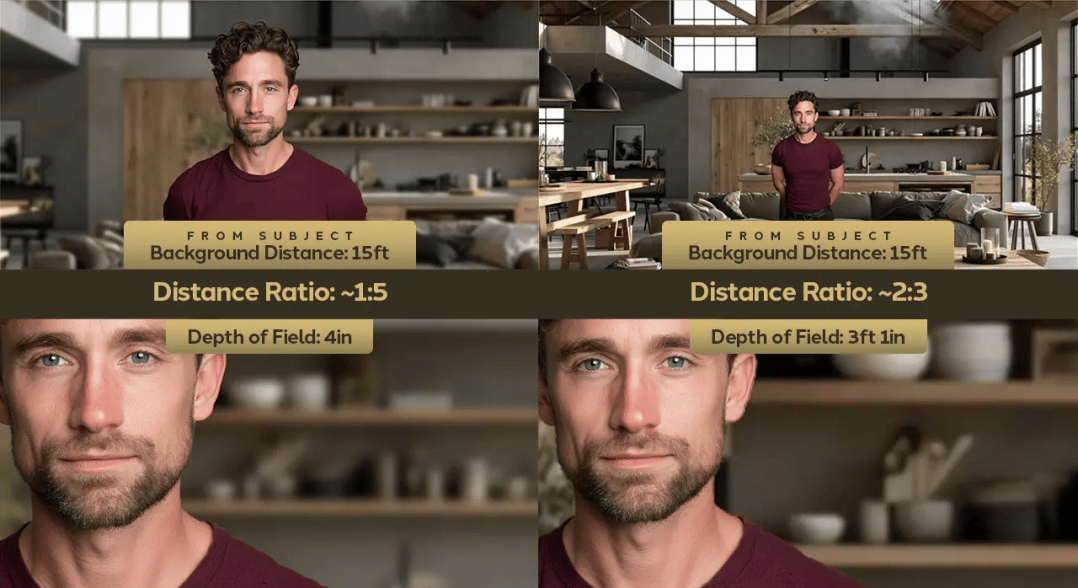
This affects what I call the "distance ratio". The distance ratio is the ratio between the camera and the subject, and the subject and the background. If your subject is 3ft (1m) from camera, and the background is 15ft (5m) from the subject, you effectively have a 1:5 distance ratio (15/3 = 5). Move the camera back to 10ft (3m) from the subject, you now have a 2:3 distance ratio, meaning that the lens's perceptual subject:background separation is less. A larger sensor camera can get much closer to the subject than smaller sensor camera on the same lens to maintain the framing.
A smaller ratio (closer to 1:1) results in a deeper depth of field, meaning the subject and background have less optical separation, while a higher ratio (values such as 1:16, 1:32, 3:128, etc.) result in a shallower depth of field.
A higher ratio not only shrinks your Depth of Field (giving you a smaller window of acceptable focus), but it also exponentially increases your Apparent Blurriness (giving you that creamy background separation).

Key Takeaway
When you match framing across sensor sizes using the same lens, the larger sensor has to move closer to the subject. That proximity — not the sensor itself — is what increases subject-to-background separation.
Why 15ft of distance isn't always the same blurriness
In our minds, distance is linear, because it is in real life. 15ft away is always 15ft away; but that's not how lenses see the world. Lenses are a cluster of moving glass elements working to focus rays of light to the same point at all times. The separation of elements doesn't result in a linear change, but rather a near-logarithmic curve known as "diopter curve". Diopter curve's math is essentially 1/distance.
This is why depth of field increases as the lens nears infinity. You've maybe heard 1ACs talk about the "1/3 2/3" rule while pulling focus. Your depth of focus is generally deeper on the far end of a focus mark, so most ACs try to land their pulls a little closer than they assume they'll need for medium to wide shots. This is because of the diopter curve. The difference in depth of field at 40t vs 130ft is virtually non-existent on a Super35 sensor with a 40mm lens at T2.8, while that same setup at 1ft focus barely has an inch of depth of field.
Look at the distance marks on any cinema lens. What is the marked distance of a 50% focus ring turn on a 40mm lens with an 11in close focus? If you guessed roughly just 1ft 8in, you would be correct. You've used over half of your focus pull just to move your focus point 9 inches. The rest of the focus pull will get you from 1ft 8in to roughly 130ft. This is that diopter curve in practice.
To help with understanding this idea, I've built a tool that makes the concept of the optical diopter curve interactive. Play around with the Aperture, Sensor Size, and Focus Distance below of a 25mm lens to see how this works on a graph along with a simulated focus ring.
What this means for blurriness
Take this knowledge, and now let's think about it linearly. If 11in to 1ft 8in is 50% of your focus turn, that means that 50% of your blurriness is only a distance of 9in, and the other 50% of your optical power is 1ft 8in all the way to infinity. This value only gets exponentially less potent as you move towards infinity with diopter math. If you focus to 50ft, now 50ft to 130ft is only using 1% of your blurriness. That's a huge range of linear distance compacted into a tiny amount of your focus pull.
Key Takeaway
The diopter curve means more than half your focus ring travel covers just a few inches of real distance at close range. The closer the camera is to the subject, the more of that focus falloff is left over to work on the background.
Having a camera closer to subject is going to allow you to save most of your blur magnitude for the distance between the subject and the background.
What you're actually getting with a larger sensor
The benefits come in a different way than you might be expecting. Let's say you really love the look of a S35 sensor at T2, but you start to run into problems with image sharpness, chromatic aberrations, and optical aberrations (vignetting, astigmatism, etc.) this is where a larger sensor can help.
Since having a larger sensor lets you get closer to the subject and increases your distance ratio, you can now operate on a smaller aperture to mitigate a lot of the optical imperfections you are wanting to avoid. A 65mm sensor like the ARRI ALEXA 65 or 265, or the Blackmagic URSA Cine 17K 65 at T4 will provide you with roughly the same depth of field and blur magnitude as a T2 on a 35mm sensor camera like the ALEXA 35, RED RANGER HELIUM, or Canon C70 while using the same lens. Allowing you to operate within the lens's "sweet spot" to get a really clean and cinema-sharp image.
This is how hollywood blockbusters are able to get that beautiful sharpness that holds up on a theater screen, and why we see so many productions moving toward larger sensors. It's not because they're chasing blurriness, but because they're chasing sharpness, while still aquiring just enough of that pleasant depth of field to give us a little more separation between the subject and the environment.
Practical Application: Lens Choices by Sensor Size
Because your field of view changes with the size of the sensor, your "go-to" focal lengths completely shift depending on the format you choose during pre-production.
To give you an idea of how this scales, here is a quick look at what is generally considered a "normal" lens (a field of view that matches the physical diagonal measurement of the sensor) across different formats:
- Super 16: 8mm to 75mm
- Super 35: 18mm to 100mm
- Full Frame (Large Format): 24mm to 135mm
- 65mm (e.g., ALEXA 65): 30mm to 200mm
- 70mm (IMAX): 50mm to 250mm
Pulling It All Together: The Dual-Axis Leverage
This shift in lens selection is where the entire puzzle locks into place. Achieving background separation is ultimately a game of optical leverage. When you choose a larger sensor format, you are forcing yourself to pull that leverage on one of two axes—and both roads lead straight back to the physics we just covered:
- The Physical Axis (Distance Ratios): If you build your package around the same focal length (e.g., a 35mm prime) and step up to a larger sensor, you have to push the camera physically closer to maintain your framing. You are directly altering the physical distance ratio, stepping right into the steepest, most sensitive part of the diopter curve where background blur explodes.
- The Optical Axis (Focal Length Compression): If you choose to keep your framing in the exact same spot to preserve your physical distance ratio, you are forced to swap to a longer focal length (e.g., jumping from a 35mm to a 50mm) to get your framing back. (See Sensor Comparison to calculate needed focal length to maintain framing between different sensors) A longer lens acts as an optical magnifier. By narrowing your field of view, it magnifies the background elements and blows up those tiny, physical background blur circles until they fill a massive percentage of your frame.
The sensor itself is never the thing bending the light to give you a shallower depth of field or increased background blur. It is simply a catalyst. Choosing a larger sensor format forces you to either physically alter your distance ratio or optically compress your frame with a longer lens. Both methods are just two different ways of exploiting the exact same diopter curve to give you the separation you want.
Summary
The next time someone tells you a larger sensor gives you more depth of field, you can tell them they're right — but probably not for the reason they think. The sensor isn't doing the work. The distance ratio is, and the diopter curve is what makes that distance ratio matter so much more than it looks like it should on paper.
Understanding this changes how you think about sensor choice on a practical level. You stop chasing sensor size as a depth of field tool and start seeing it for what it actually is: a way to operate your lenses at apertures where they perform their best, while letting physics handle the separation.

Written by
Sam Crowe
Director of Photography · Colorist · Camera Operator
I'm a cinematographer based in Nashville with over a decade of experience shooting across the Southeast. I care about images that serve the story — not the other way around. Outside of production, I spend a lot of time thinking about the technical side of the craft and building tools that help other cinematographers work smarter on set.
Frequently Asked Questions
No. If you keep the focal length, aperture, and camera-to-subject distance identical, the physical depth of field does not change when switching sensors. A larger sensor simply captures a wider field of view (less crop). The perception of a shallower depth of field only occurs when you alter your lens choice or move closer to match your framing.
The distance ratio is the proportional relationship between your camera-to-subject distance and your subject-to-background distance. When you choose a larger sensor and move the camera closer to your subject to maintain framing, you shift this ratio. This forces the lens to operate on a steeper section of the optical diopter curve, which drastically accelerates background blur.
In practical pre-production planning, shooting on a larger sensor forces you to make one of two choices to achieve a specific composition: you must either use a longer focal length lens or physically position the camera closer to your subject. Both of these adjustments — longer glass and closer proximity — are the actual physical catalysts that thin out your focus plane.